How to Avoid Hidden Auction Fees in Japan

A Japanese auction sheet may show a clean grade, desirable options, and a bid price that looks well below comparable retail listings. That is the point where experienced buyers slow down. To avoid hidden auction fees, you need to separate the auction winning price from the complete cost of putting that vehicle on a ship with the correct export documents.
The lowest apparent purchase price is not always the lowest landed cost. Auction buying in Japan involves several legitimate charges, and they are not inherently a problem. Problems begin when an exporter gives a vague total, uses estimates without explaining what can change, or leaves key services out until after a bid is won.
A transparent importer should be able to tell you what is included, what is estimated, what is optional, and what costs depend on the specific vehicle or destination. Get that clarity before bidding, not after an auction has closed.
Know What the Auction Price Actually Means
The hammer price, sometimes called the winning bid, is only the amount paid to secure the vehicle at auction. It is not a delivered export price. It generally does not include the auction house charge, agent or exporter service fee, domestic transport, inspection work, export preparation, ocean freight, marine insurance, or destination-country charges.
Auction houses also apply their own fees. These can vary by auction group, vehicle type, sale price, and whether the vehicle is purchased through a dealer account. A transparent exporter should identify this as an auction fee or auction house fee rather than quietly burying it in an unexplained number.
There is no universal flat fee for every Japanese auction purchase. That is why a quote should show both fixed charges and variable charges. If a provider says all auction purchases carry the same cost regardless of location, size, value, or shipping method, ask for a written breakdown.
The difference between a quote and an estimate
Some costs can be quoted precisely before you bid. An exporter’s service fee, an inspection fee, or a documentation charge should normally be clear in advance. Other figures, especially domestic transport and ocean freight, may be estimates because they depend on pickup location, vessel schedules, fuel surcharges, port congestion, and the vehicle’s dimensions.
An estimate is reasonable when it is labeled as one and the reason for variability is explained. It becomes a concern when it is presented as a firm total, then revised after you have committed funds. Ask what assumptions were used: the Japanese departure port, the destination port, roll-on/roll-off versus container shipping, and the expected vehicle dimensions.
Build a Complete Pre-Bid Cost Sheet
Before setting your maximum bid, request a written cost sheet tied to the actual vehicle and destination. This is more useful than asking, “What will it cost to import?” A complete answer needs a specific auction location, vehicle type, port, and shipping method.
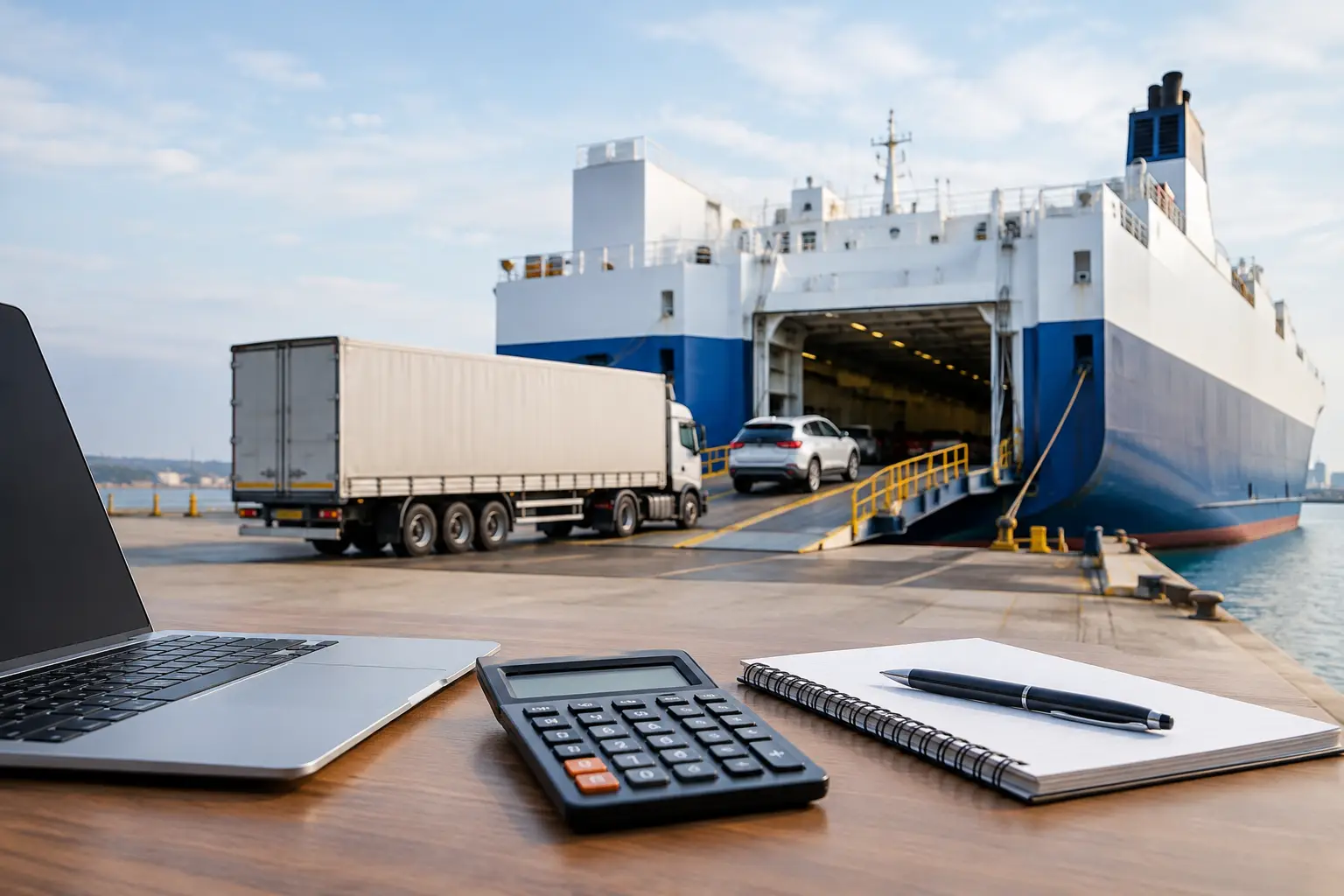
Your pre-bid calculation should account for the winning bid, auction house fee, exporter or broker fee, inspection charge, domestic transport to port, export documentation, port handling, ocean freight, and marine insurance if selected. For many buyers, that is the full Japan-side and shipping cost. It is not necessarily the final cost to drive the vehicle at home.
Destination expenses may include customs duty, taxes, port handling, broker fees, compliance work, inspection requirements, registration, and inland delivery. These are often paid to parties outside Japan, but they still matter when you are comparing bids. A low Japan-side quote can look attractive while leaving thousands of dollars in destination costs unaddressed.
For U.S. buyers, eligibility and customs requirements should be confirmed before any bid is placed. A vehicle that cannot be legally imported under the applicable federal rules is not a bargain at any price. Buyers in Australia, Canada, the United Kingdom, New Zealand, and Europe also face country-specific age, compliance, inspection, tax, and clearance requirements. Those requirements can affect both timing and cost.
Ask How Each Fee Is Earned
A line-item invoice is not just about price. It tells you what work is being performed and who is accountable for it. An export service fee may cover bidding, payment processing, auction coordination, document preparation, booking logistics, and communication. That can be good value if the service is actually delivered.
The same applies to inspection charges. A basic auction-sheet translation is not the same as a physical inspection. Auction reports are valuable, but they are prepared quickly and can have limitations. They may not reveal every odor, underbody concern, prior repair issue, drivetrain noise, warning light, or sign of corrosion.
If you are paying for an in-person inspection, ask what the inspector will check and how findings will be reported. Useful reporting includes clear photos, close-ups of damage, tire condition, interior wear, underbody observations where accessible, cold-start feedback when permitted, and direct comments on concerns that matter to your intended use.
Direct Imported Japan works from physical auction locations and approaches the inspection fee as a decision-making service, not a generic box on an invoice. For collectors and dealers, that distinction can prevent a costly purchase based on attractive photos alone.
Fees that may be optional, but should never be a surprise
Not every buyer needs every service. Storage may apply if a vehicle waits for consolidation or a sailing. Container loading is different from roll-on/roll-off handling. Marine insurance may be optional depending on your shipping arrangement, although declining it should be a deliberate decision rather than an assumption.
Common add-ons that deserve advance discussion include JEVIC odometer certification, pre-shipment inspection programs, radiation inspection where required, fumigation for certain markets, spare-parts handling, storage, and inland transport after arrival. The correct package depends on the destination and the vehicle, but the existence and likely cost of these items should be discussed before funds are sent.
Watch for Pricing Language That Hides Risk
Terms such as “all-inclusive,” “starting from,” and “delivered to port” can be useful, but only when their boundaries are clear. “Delivered to port” may mean the Japanese export port, the destination port, or a local delivery point. Those are very different promises.
Be cautious when a seller will not provide a sample invoice, cannot explain whether auction fees are included, or asks you to bid before confirming the maximum all-in Japan-side cost. Another warning sign is an unusually low commission paired with unclear charges for paperwork, transport, storage, or shipping administration.
Also ask how exchange-rate changes are handled. If you pay in U.S. dollars while the auction purchase is settled in Japanese yen, there may be a currency conversion margin or a rate movement between deposit and final payment. Neither is automatically unfair. It should simply be disclosed, with the rate source and timing explained.
Deposits deserve the same attention. Confirm whether the deposit is refundable if no vehicle is purchased, what happens if you withdraw a bid after approval, and how deposits are applied to the final invoice. Japanese auctions are binding once a bid wins. A serious exporter will make that clear before you authorize bidding.
Use Inspection to Protect the Budget, Not Just the Vehicle
Buyers often focus on fees because they are easy to measure. The more expensive surprise may be a vehicle that needs paintwork, rust repair, tires, mechanical diagnosis, or parts after arrival. Saving a small amount on an inspection can be false economy on a specialty import.
Set a bid ceiling that includes a realistic repair reserve. Auction grades are helpful shorthand, not a mechanical guarantee. Grade 4 does not mean flawless, and an R or RA grade does not automatically mean a vehicle should be rejected. It means the repair history and quality of work need to be understood. The right vehicle may carry a lower grade but have honest documentation, better maintenance, and a price that leaves room for proper reconditioning.
For a dealer, that reserve protects your gross margin. For a private buyer, it protects the enjoyment of the vehicle after it reaches your driveway. In both cases, a candid inspection report is more valuable than a seller who only tells you what you want to hear.
Confirm the Final Invoice Before Shipping
After the vehicle is won, ask for a final pro forma invoice before shipping is booked or before the balance is transferred. Compare it with the pre-bid cost sheet. Any difference should be explained by a specific event: a changed freight rate, a longer domestic tow, an added certification, storage requested by the buyer, or revised port charges.
This is also the time to verify the vehicle identification number or chassis number, sale price, auction location, shipping method, consignee details, and documents to be supplied. Depending on the destination, you may need the export certificate, bill of lading, commercial invoice, packing information for container shipments, odometer records, inspection certificates, and other customs paperwork.
A good partner will not treat these questions as inconvenient. Clear documentation protects the exporter, the buyer, the customs broker, and the vehicle’s future resale value.
The practical rule is simple: do not judge a Japanese auction vehicle by the bid price alone. Judge it by the documented cost to buy, inspect, prepare, ship, clear, and put it into service. When every charge has a name, a purpose, and a point of accountability, you can bid with confidence and keep your attention where it belongs: finding the right vehicle.