How to Verify Japanese Car Auction Mileage

A low odometer reading can make a Japanese auction vehicle look like a rare find. It can also be the one detail that changes the value of the car most dramatically if it is wrong. To verify Japanese car auction mileage properly, you need more than the number printed on an auction sheet. You need to know where that number came from, whether auction staff have questioned it, and whether the vehicle's physical condition supports the story.
For an overseas buyer, mileage verification is not a box to tick after winning the bid. It is part of deciding what the vehicle is worth before you authorize a purchase. This matters particularly with collector JDM cars, where the difference between 45,000 verified miles and an unconfirmed reading can affect resale value, insurance, future registration, and buyer confidence.
Why Japanese Auction Mileage Needs Verification
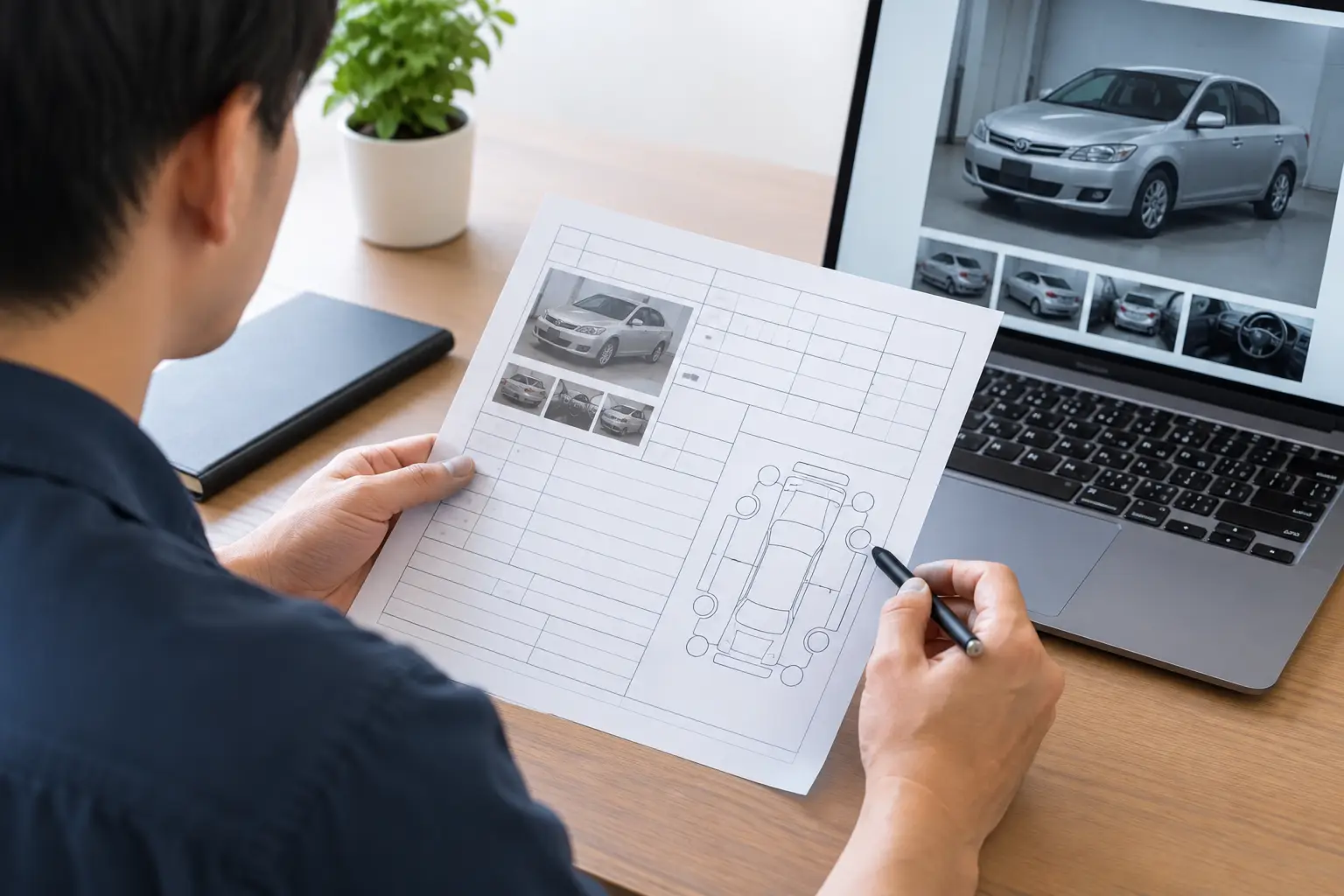
Japanese vehicle auctions record an odometer reading on the auction sheet, but an auction sheet is an assessment document, not a lifetime service record. Auction inspectors compare the displayed mileage with available auction history, vehicle condition, and the information supplied by the seller. When a discrepancy is identified, the sheet may carry a notation such as an asterisk, a question mark, or a Japanese remark indicating that the mileage is unknown, changed, or cannot be guaranteed.
The exact notation and procedure vary by auction group. USS, TAA, JU, ARAI, CAA, and smaller regional auctions do not all present mileage concerns in precisely the same way. A clean-looking sheet from one venue should never be treated as proof that no issue exists.
There is also a practical distinction between a reading that appears plausible and one that is independently documented. A 1995 Skyline showing 62,000 kilometers might have a tidy interior and a credible auction history. That is encouraging. It is still not the same as a certified odometer result. Conversely, a car with an odometer replacement can be legitimate, provided the replacement is disclosed and the available records support the total mileage. The problem is undisclosed or unprovable mileage, not automatically every changed instrument cluster.
How to Verify Japanese Car Auction Mileage Before You Bid
A reliable check combines document review, auction-history research, and a physical inspection. No single step should carry the full burden of proof.
Read the auction sheet beyond the mileage box
Start with the displayed odometer figure and the auction grade, then read every inspector comment. The mileage field may show kilometers, but comments elsewhere on the sheet can qualify that figure. Look for notes relating to meter exchange, mileage uncertainty, warning lights, service records, or missing documentation.
Do not assume a high auction grade confirms mileage. Auction grade primarily reflects the auction's assessment of the vehicle's overall exterior, interior, and condition at the time of sale. A Grade 4 vehicle may still have a mileage notation that deserves investigation. Likewise, a lower-grade car may have fully credible mileage but cosmetic repairs or age-related defects.
Translation matters here. A machine translation can miss the difference between a confirmed meter reading and a comment that says the reading is not guaranteed. Ask for a complete English explanation of handwritten and printed auction remarks, not just a headline grade and mileage figure.
Compare prior Japanese auction records
Auction history is one of the strongest tools available. If the same vehicle appeared at a Japanese auction previously, its chassis number, auction date, mileage, grade, and remarks may establish a useful timeline. Readings should progress logically over time.
A car showing 118,000 kilometers in 2022 and 54,000 kilometers in 2025 is an obvious concern unless there is documented evidence of a meter change and the total distance is clearly explained. Smaller inconsistencies require judgment. A difference of a few kilometers can arise from transport or record timing, while a sudden drop of thousands cannot be ignored.
History searches are valuable but not perfect. A vehicle may have been sold privately, kept by one owner for years, or passed through an auction whose earlier record is unavailable. In those cases, the absence of a contradiction is not confirmation. Treat it as one layer of evidence, then place greater weight on inspection and certification.
Match the car's condition to its claimed mileage
Do we sit behind a computer and simply repeat what an auction sheet says? No. A physical inspection is where claimed mileage meets the vehicle itself.
Wear patterns can reveal whether the reading makes sense. Inspect pedal rubbers, steering wheel texture, driver-seat bolsters, shift knob wear, switch labels, door handles, and carpet condition. Check the engine bay, underbody, suspension bushes, and brake component wear in the context of the vehicle's age and reported distance. A 30-year-old car with low mileage can still show age-related deterioration, but it should not normally present the broad cabin wear of a high-mile example.
These signs are indicators, not a verdict. A steering wheel may have been replaced, a seat may have been reupholstered, and pedals can be renewed inexpensively. That is why a hands-on inspection should identify both reassuring details and items that prevent a firm conclusion. Clear reporting is more useful than a blanket promise.
Check service books, inspection stickers, and maintenance evidence
Japanese service books, maintenance invoices, and periodic inspection paperwork can support an odometer timeline. A service record dated several years earlier with a matching chassis number and lower mileage is useful evidence. Windshield inspection stickers may also provide clues, although they should not be relied upon by themselves because windshields can be replaced.
Original documentation is especially valuable on low-mileage collector cars. Missing books do not automatically mean a car has been altered. Many older vehicles have incomplete paperwork. It does mean the buyer should avoid paying the same premium as they would for a comparable example with traceable history and certification.
When JEVIC Odometer Certification Adds Value
JEVIC certification provides an additional, independent mileage verification process for eligible vehicles. It is particularly useful when the destination market, dealer policy, insurer, or future buyer expects formal evidence rather than an auction statement. The inspection result can help document the odometer reading and whether the mileage is assessed as consistent with the vehicle's history and condition.
Certification is not a substitute for choosing the right car. It cannot erase accident repairs, corrosion, mechanical faults, or poor maintenance. It also depends on the vehicle and inspection program being eligible. But for a vehicle whose value rests heavily on low kilometers, it can be one of the most worthwhile pre-export steps.
For buyers in markets with pre-shipment inspection requirements, mileage verification may also sit alongside compliance checks. Australia, for example, has specific import approval and inspection processes, while U.S. buyers must consider the 25-year federal import rule and state-level registration requirements. Those processes are separate from mileage validation, but the documents should tell a consistent story from auction purchase through export and arrival.
Red Flags That Should Change Your Bid
Some concerns justify a lower bid. Others justify walking away until the evidence is clearer. Be cautious when the auction sheet marks mileage as unknown or unverified, when history shows a backward reading, or when an unusually low-kilometer car has condition that does not support the claim.
The same applies when a seller offers only cropped photos, declines to provide the full auction sheet, or relies on phrases such as “believed genuine” without documentation. A low reading with no prior history is not necessarily fraudulent, but it is not a low-mileage premium car until the evidence supports it.
Meter replacement deserves a more measured approach. If the replacement is declared, the original reading is recorded, and the total distance is documented, it may be an acceptable purchase at the correct price. If the explanation is vague or the totals do not reconcile, treat the mileage as unknown. Honesty in the file matters as much as the number on the dash.
Build a Mileage File Before Export
Before the vehicle leaves Japan, retain the complete auction sheet, translated remarks, auction-history results, inspection photographs, JEVIC certificate where applicable, and any service documentation. Keep these with the export certificate, bill of lading, and purchase records.
This file protects more than the initial transaction. A dealer can show a future retail customer how the mileage was assessed. A collector can support provenance when selling years later. If questions arise during customs, registration, insurance, or appraisal, you have contemporaneous records rather than a verbal assurance after the fact.
At International Auto Select Japan, we treat an odometer question as a buying decision, not a sales obstacle. If the evidence supports the reading, you should see why. If it does not, you should know that before your bid is committed.
The right Japanese auction car is not always the one with the lowest number on the dash. It is the one whose mileage, condition, records, and price all agree well enough for you to buy it with clear expectations.